
SureSMS guide
SMS gateway for businesses: How to choose the right solution
An SMS gateway is not just a way to send messages. For many businesses, it's the link between customers, systems, operations, security and marketing. Here's a handy guide to what you should look for before choosing a platform.
Main points
- A good SMS gateway should fit your technical needs, your customer journey and your security and documentation requirements.
- API, deliverability, sender name, two-way communication, reporting and compliance are more important than just comparing price per SMS.
- Start by defining your use cases: operations, login codes, reminders, support, marketing or a combination.
If your business sends SMS today, or is considering doing so, choosing an SMS gateway is an important decision. It's not just about being able to send a message from A to B. It's about how stable the message is sent, how it fits into your systems, whether the customer can recognize the sender, and whether you can document what happened if a message is not delivered.
SMS is often used in situations where the message needs to be seen quickly: a login code, a delivery update, a booking reminder, a payment reminder, an operational message or an important message to members, customers or employees. Therefore, the SMS gateway should be considered as part of the company's communication infrastructure - not just as a simple broadcasting tool.
What is an SMS gateway?
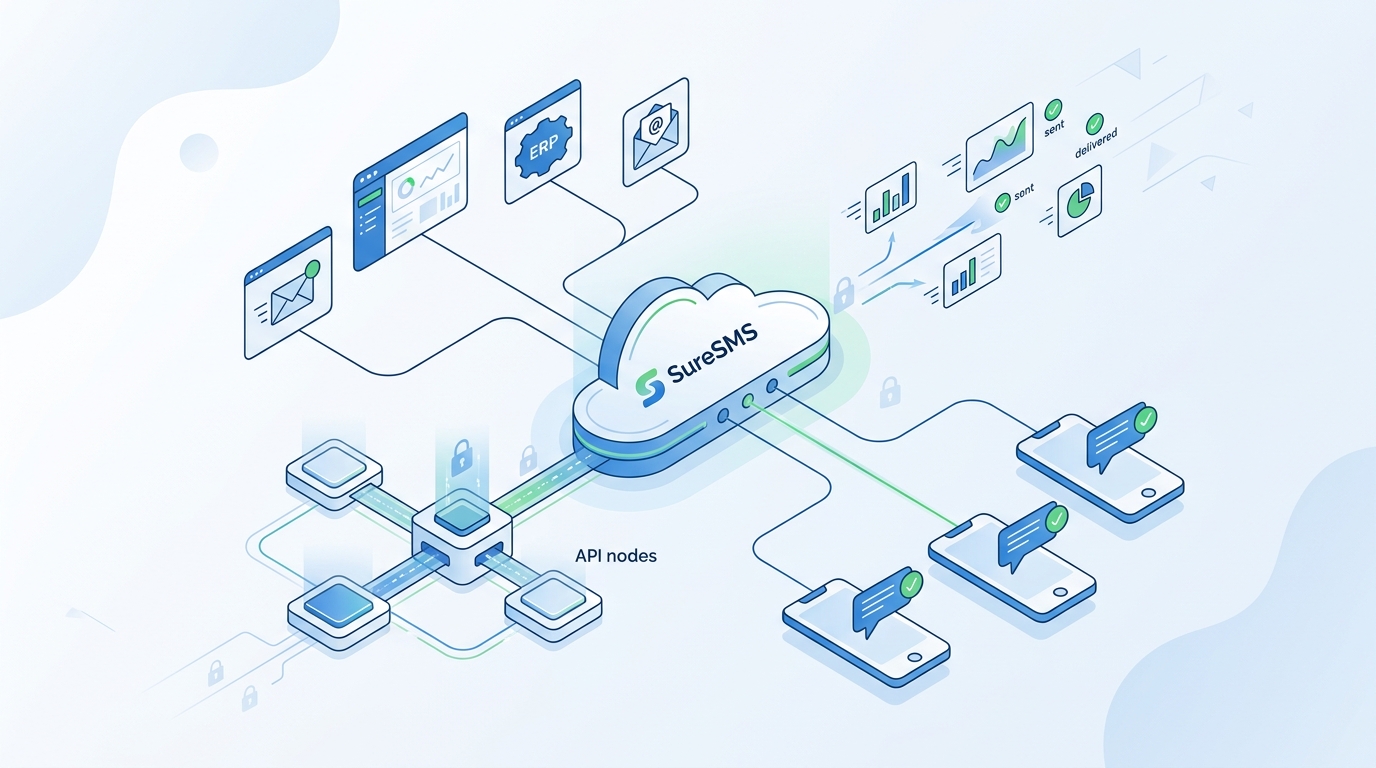
An SMS gateway is the platform that connects the company's systems to the mobile networks, allowing the company to send and in some cases receive SMS messages on a larger scale. Instead of an employee sending messages manually from a phone, messages can be sent automatically from a CRM system, a webshop, a booking system, an app, a financial system, a support platform or an internal database.
The typical flow looks like this: A system triggers a message, the SMS gateway receives the message, the gateway forwards it to the relevant mobile network, the recipient receives the SMS, and the company gets a delivery status back. In practice, this means that SMS can become an integral part of the customer journey.
For the customer, it feels simple: The message lands directly on the phone. For the business, the value is in the automation, documentation and control.
Describe your main SMS scenarios first before evaluating vendors. A solution for monthly campaigns should be evaluated differently than a solution for login codes, alerts or automatic operational messages.
Why do businesses use an SMS gateway?
SMS still has a special strength: The message doesn't require an app, an account, a push permission or a specific platform. The recipient just needs a cell phone. This makes SMS suitable for both broad audiences and critical messages.
Businesses typically use an SMS gateway for:
- Order confirmations and delivery updates
- booking and appointment reminders
- Login codes, OTP and two-factor authentication
- Payment reminders and account notifications
- Operational messages, schedules and internal notifications
- Customer service updates and case status
- Marketing campaigns, loyalty messages and reactivation
- critical messages to citizens, members, patients or employees
Common to most applications is that timing and relevance matter a lot. A reminder should come before the appointment - not after. A login code needs to arrive quickly. A delivery update must be accurate. A marketing message should be based on consent and hit the recipient at a sensible time.
The most important requirements for a professional SMS gateway
When comparing SMS gateways, you should look at more than the visible message price. The cheapest solution can be expensive if the API is difficult to integrate, delivery data is incomplete, support is slow or the solution doesn't support the countries and sender types your business needs.
1. A good and well-documented API
For many companies, the API is the most important part of the SMS gateway. An SMS API makes it possible to send messages automatically from your own systems. It could be a webshop sending delivery status, a booking system sending reminders or a login solution sending one-time codes.
A good API should be stable, well documented and easy for developers to work with. Look for clear examples, good error handling, version control, testing options and a simple way to manage keys and access. If your developers have to spend unnecessary time on the integration, the total cost will quickly become higher than expected.
2. Delivery reliability and scalability
Some companies send a few messages a week. Others send thousands or millions of messages, especially during promotions, operational alerts or peak periods. The SMS gateway needs to be able to handle both your normal traffic and the periods when volume increases.
Ask about capacity, throughput, queue management and experience with larger broadcasts. This is especially important if SMS is linked to time-critical processes such as login, delivery, health, scheduling or alarms.
3. Delivery reports and status data
A professional SMS gateway should provide access to delivery reports. It's not enough to know that a message has been sent from your system. You also need to be able to see if it has been delivered, failed, pending or possibly rejected.
Delivery data helps operations, support and marketing. Support can see if the customer actually received the message. Marketing can measure the quality of campaigns. IT can detect errors in integrations. Management can get a better picture of channel performance.
4. Webhooks for automation
If delivery status and replies are to be used in your own systems, webhooks are essential. With webhooks, the SMS gateway can send messages back to your system when an SMS gets a new status or when a customer replies.
This makes it possible to automate follow-up. If a message fails, the system can try another channel. If a customer replies YES to an appointment, the booking system can update the appointment. If a customer replies STOP, the marketing list can be updated correctly.
5. Sender name and recognizability
The sender is important for trust. If the customer can recognize the company, the message is more likely to be read and understood. Depending on the country and operator, there may be different options: alphanumeric sender name, long number, short number or protected sender identity.
It's important to clarify what's possible in the markets you ship to. Rules and options vary from country to country. A solution that works well in Denmark is not necessarily the right setup in all other countries.
6. Two-way communication
Some messages don't require a reply. A login code or a simple delivery notification is often one-way. Other scenarios are better if the customer can respond directly: confirm an appointment, cancel a campaign, give feedback, send a keyword or contact customer service.
If responses are relevant, the SMS gateway must be able to receive and handle incoming messages. It should also be clear where the responses end up: in a dashboard, in a CRM system, in a support queue or in your own application.
7. Consent, opt-out and data protection
Compliance is not an extra layer that can be added at the end. It needs to be built in from the start. Marketing SMS requires proper consent, clear expectations and a simple way to unsubscribe. Messages with personal data require control of access, data processing and documentation.
Ask the vendor how the solution supports opt-in, opt-out, logging, user access, API keys, data processing agreement and local regulations. This is especially important in industries such as healthcare, finance, public sector, membership organizations and companies with sensitive customer data.
Don't choose an SMS gateway based on price per message alone. If the solution lacks reporting, support, sender control or proper handling of consent, the consequence can be poor customer experiences and more manual work.
Want to use SMS more efficiently?
SureSMS helps businesses provide secure, simple and efficient SMS communication to customers, members and employees.
See the possibilities with SureSMSSMS API or web platform?
The right choice depends on who needs to send the messages and how the messages are created.
An SMS API is best suited when messages need to be triggered automatically from systems. For example, login codes, order confirmations, delivery notifications, booking reminders, payment reminders, operational notifications and other system-generated messages.
A web platform is best suited for employees to create, plan and send campaigns without developer help. This typically includes news alerts, member communication, customer information, promotions, loyalty, events and reactivation.
Many companies need both. The API handles the automated and time-critical messages, while the web platform makes it easy for marketing, customer service or administration to send scheduled messages.
Usage scenarios: What type of SMS are you sending?
A good way to choose a solution is to split messages according to business needs.
- Security: OTP, 2FA, account verification and login messages require fast delivery and stable reporting.
- E-commerce: Order confirmations, delivery updates and pickup notifications require integration to the webshop and logistics.
- Booking and service: Appointment reminders, changes and confirmations can reduce no-shows and improve customer service.
- Economy: Payment reminders and account notifications require clear text, correct timing and good documentation.
- Marketing: Promotions, loyalty and reactivation require consent, segmentation, opt-out and measurement.
- Operations and preparedness: urgent messages to employees, citizens or members require scalability and high reliability.
Knowing your scenarios makes it easier to ask the right questions to the supplier.
Questions to ask before choosing an SMS gateway
Here's a handy checklist that can be used internally or in dialog with a supplier:
- Which systems should be able to send SMS?
- Should messages be sent manually, automatically or both?
- Which countries should you be able to ship to?
- Do you need a specific sender name or a number customers can respond to?
- Should customers be able to reply directly to messages?
- Do you need delivery reports in your own system?
- Do you need webhooks for status, replies or unsubscribes?
- How much volume do you expect on normal and peak days?
- Who should be able to create messages: developers, marketing, customer service or operations?
- How do you handle consent, opt-out and data protection?
- What support do you need during setup and operation?
Typical mistakes when choosing an SMS gateway
The most common mistake is to start with the price list instead of the need. Price is of course relevant, but it should be seen in the context of features, support, integration and delivery quality.
Other typical errors are:
- choosing a gateway without testing the API documentation
- Overlooking the need for delivery reports and error codes
- Forgetting about peaks and campaign volume
- Assuming the sender name works the same in all countries
- Using a campaign platform for messages that should be automatic
- Using an API for tasks that the marketing team could more easily handle in a web platform
- Mixing operational SMS and marketing SMS without clear consent rules
- Lacking a plan for unsubscribes, responses and errors
The best choice comes when you first define the purpose and then choose the solution that fits the purpose.
Frequently asked questions about SMS gateways
What is the difference between an SMS gateway and an SMS API?
The SMS gateway is the platform that sends the messages via mobile networks. The SMS API is the technical access that enables your systems to send messages automatically through the gateway.
When should we choose API?
Choose API when messages should be triggered by system events: an order, a booking, a login process, a payment, a case in customer service or an internal operational process.
When should we choose a web platform?
Choose the web platform when people need to create, schedule and send messages without development. This is especially relevant for campaigns, member communication, customer lists, events and scheduled information.
Can customers reply to SMS messages?
Yes, if the setup supports two-way communication. This typically requires a number or sender setup that can receive replies and an agreement on where to handle the replies.
Is SMS suitable for marketing?
Yes, SMS can be very effective for marketing when consent, relevance, segmentation, timing and unsubscribing are taken care of. Read also our guide to SMS marketing.
Conclusion: Choose gateway by need - not just price
The right SMS gateway makes it easier to send the right message at the right time. It should integrate with your systems, provide insight into delivery, handle relevant sender types, support replies and unsubscribes, and provide peace of mind around security and compliance.
Start by mapping your use cases. Is it operations, security, customer service, booking, payment, marketing or something else entirely? Then assess whether you primarily need an API, web platform or a combination.
At SureSMS, we work with SMS solutions for companies that want to communicate simply, securely and effectively. If you need to choose the right setup, it's often a good idea to take your specific customer journey as a starting point - and embed SMS where the message creates the most value.